
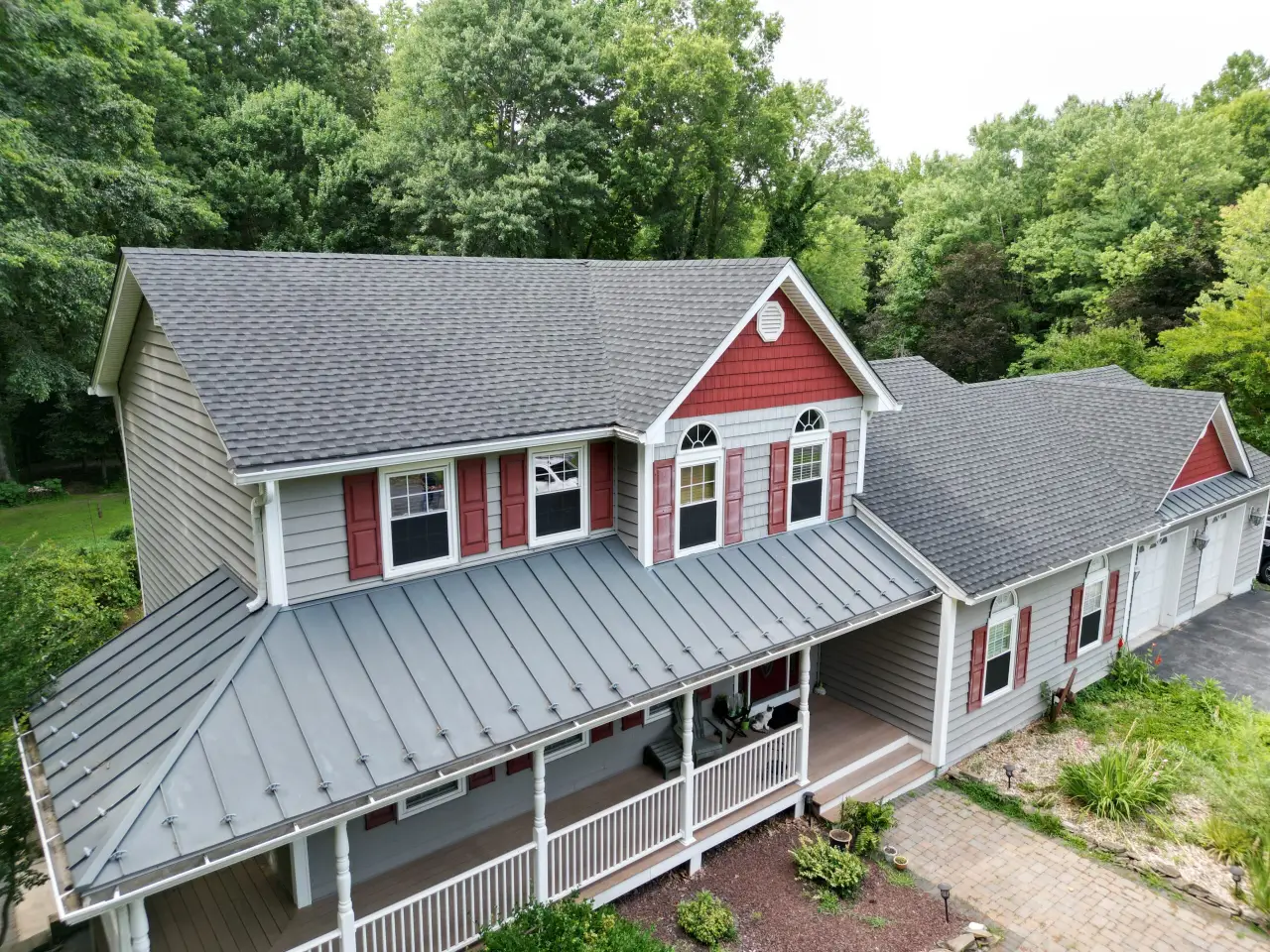
Roof repair vs replacement: learn how Maryland homeowners can tell the difference, what a real inspection checks, and when each option makes sense for a house.
How to decide between a repair and replacement?
A leaking or aging roof does not automatically mean you need a new one. The old roof repair vs replacement decision comes down to a few clear factors.
Here is how Maryland homeowners can:
- Know the difference between a roof repair and a roof replacement
- What an honest inspection actually checks
- How to decide which option fits your home
Roof repair or roof replacement? The short answer
- Roof Repair when the damage is small and the roof is still young.
- Roof Replacement when the damage is widespread or the roof is near the end of its life.
Almost everything a good contractor checks is really a way of answering those two questions.
Localized damage does not require a roof replacement
A roof repair is often the right call when the problem is contained to a specific area and the rest of the roof is in suitable shape.
A roof replacement tends to make more sense once leaks keep returning, wear shows up across several sections, or repeated repairs stop holding.
How to choose between Roof Repair and Roof Replacement?
| A roof repair is needed when… | A roof replacement is needed when… |
|---|---|
| The damage is limited to one area or slope | Problems show up across several sections, not one spot |
| The roof is in the first half of its expected life | The roof is in the last third of its service life |
| The decking underneath is still solid | You have paid for repeated repairs in a short span |
| The surrounding shingles still hold their granules | Shingles are widely curling, cracking, or shedding granules |
| Matching materials are still available for a clean repair | The decking is soft, sagging, or water-stained |
How old is the roof?
The first thing most contractors consider is how old the roof is, because age sets the stage for everything else. It helps to know the typical service-life ranges. These are general industry guidance to choose:
| Roofing material | Typical service-life range | Notes |
|---|---|---|
| 3-tab asphalt shingles | About 15 to 20 years | Most affordable; wears faster under heavy sun and wind exposure |
| Architectural (dimensional) shingles | About 25 to 30 years | Thicker and more durable than 3-tab; the common re-roof choice |
| Standing seam metal | About 40 years or more | Long service life; holds up well to wind and heavy rain |
One important note: the “30-year” or “50-year” figure stamped on a shingle is the manufacturer warranty period, not a guaranteed real-world lifespan. Real-world roofs commonly land toward the middle of these ranges.
If a roof is relatively new and dealing with a localized issue like storm damage or a flashing failure, repair is usually the logical option because the rest of the system still has plenty of life left.
If the roof is already into the later stages of its lifespan, fixing one area can simply reveal the next weak spot. Age alone does not force a replacement, but it does frame the rest of the evaluation.
How widespread is the damage?
After age, the next question is scope. A few shingles lifted after a windstorm, or failed flashing around a chimney or vent, is often a straightforward repair.
When damage spreads across large sections or multiple slopes, the math changes, because several failing areas suggest the roof system itself is wearing out.
At that point, repairs start to look more like temporary patches than lasting fixes.
What about the “25% rule”?
Some homeowners hear about a “25% rule” as a rough guideline, when roughly a quarter or more of the roof is damaged, or when a repair would cost a large share of a new roof, replacement often becomes the more sensible option.
There is also a code dimension:
Many building codes limit how much of a roof can be repaired or recovered within a 12-month period before the whole roof section must be brought up to current code.
What are the shingles telling you?
The condition of the shingles reveals a lot about remaining life. Granules protect the asphalt layer beneath from sun and moisture.
When shingles are shedding granules heavily, curling at the edges, or cracking across the surface, the material is aging past the point where patching a few of them changes the larger picture. Heavy granule buildup in the gutters years after installation is a common sign of this wear.
Leaks are widely misunderstood
A leak does not automatically mean the roof has failed.
Many leaks come from localized issues, and because water travels along the path of least resistance, the interior stain may not sit directly below the actual roof failure.
Flashing around vents, chimneys, or skylights can fail while the surrounding shingles are still sound, and those cases are often repairable.
The key is whether the leak is isolated or part of a broader pattern. If you have patched leaks in the same roof more than once, the roof may be past the point where repairs are the practical choice.
The decking and the repair history matter too
Contractors also consider the decking, the wooden layer beneath the shingles.
If water has been getting into the system for a long time, the decking can become soft or deteriorated, and simple surface repairs will not address what is happening underneath.
This is one reason a sagging or uneven roofline is treated as a more serious sign and evaluated promptly rather than left through another season.
Repair history is another factor
A roof that has been patched again and again can reach a point where more patching stops making sense. Two repairs in a couple of years on an older roof is less a maintenance pattern and more a system signaling that it is near the end.
None of this means earlier repairs were wrong. It just means the roof has moved into a new phase of its life.
The honest cost comparison
Repairs almost always cost less than a replacement on any single visit, so at a glance repair looks like the obvious choice.
The more useful question is what happens over the next several years. If an aging roof needs a repair now, another one a few months later, and a third the following year, those costs stack up on a roof that still ends up needing replacement.
A common industry guideline is that once a repair approaches a significant share of the cost of a new roof, replacement usually provides better value per year of protection.
Budget and how long you plan to stay in the home are legitimate parts of this conversation, and a good contractor should lay out both options honestly instead of pushing one.
What you can safely check from the ground
You can learn a lot without getting on the roof, and you should not climb up to inspect it. On-roof and attic inspection is best left to a professional. From the ground or a second-floor window, look for:
- Shingles that are curling, buckling, cracked, or missing
- A visible dip or sag anywhere along the roofline
- Granules collecting in the gutters or at downspout outlets
- Dark streaks, moss, or heavy algae growth on the surface
- Damaged or missing flashing around chimneys, vents, and skylights
- Interior signs such as ceiling stains, damp attic insulation, or a musty smell
Photograph anything that looks off from a safe spot, especially after a major storm. Those photos help a contractor and give you a record for your own files.
What Maryland’s weather does to a roof
Roofs across Calvert, Anne Arundel, and St. Mary’s Counties deal with humidity, heavy summer thunderstorms, wind-driven rain, and the occasional tropical system moving up the coast.
Repeated wind and rain can loosen shingles and work at flashing over time, and winter freeze-thaw swings can widen small cracks.
None of this means a particular material is required simply because you live in Maryland, but it does mean a roof here earns a closer look after major storms, especially if you notice missing shingles or debris in the yard afterward.
How to trust the recommendation you get
Plenty of homeowners worry that a roofer will push a full replacement when a repair would do. It is a fair concern, and the way to protect against it is simple: work with someone who does both repairs and replacements and has no reason to steer you one way.
A useful inspection includes a look at the flashing, ventilation, and decking, along with photos of what the contractor is seeing and a written explanation of why repair or replacement is the right call for your specific roof.
Be cautious of anyone who recommends a full replacement before actually getting up to look.
At Elite Project Services, owner Tom Lowe personally handles inspections and estimates, so the person assessing your roof is the same person standing behind the recommendation. If a roof repair will solve the problem, that is what gets recommended.
How EPS approaches a roof evaluation
Elite Project Services (EPS) is a family-owned exterior contractor serving Southern Maryland since 2006. A typical evaluation follows a clear path:
- Free estimate and evaluation: EPS looks at the visible condition of the roof and the areas that may need repair or replacement.
- Clear recommendations: Tom explains the recommended scope and the available asphalt shingle or metal roofing options before any work is agreed to.
- Professional work: For a repair, the crew addresses the source of the problem. For a replacement, they remove the existing materials, evaluate the visible decking, and install the approved system.
- Final review and cleanup: EPS reviews the completed work, confirms the area is cleaned, and answers any remaining questions.
If cost timing is a concern, financing is available for qualifying projects. EPS provides service throughout its Southern Maryland service areas, including Dunkirk, Owings, and Huntingtown.
Not sure whether you need a repair or a replacement?
EPS provides free, no-obligation roof inspections and written estimates across Southern Maryland. Tom will walk the property, explain the findings, and lay out your options. Request a free estimate.
Frequently asked questions about roof repair vs replacement
Is it better to repair or replace a roof? Should I repair or replace my roof?
It depends on the roof’s age and how widespread the damage is, and repair is not automatically the lesser option. If the roof is in the first half of its life and the damage is limited to one area, a repair is usually the better value and the smarter choice. If the roof is nearing the end of its lifespan or damage shows up in several places, replacement often costs less over time than a string of repairs.
How much does it cost to repair a roof?
Roof repair cost depends on what is actually wrong. A few replaced shingles or a small flashing fix sits at the lower end, while tracing an active leak, repairing a valley, or addressing damaged decking costs more. Access, roof slope, and material matching also factor in. Because the scope varies so much from roof to roof, EPS provides a written estimate after looking at the visible condition of the roof.
How much is a roof replacement?
Replacement cost is driven by the size of the roof, the material selected, the roof slope, how many existing layers must be removed, and the condition of the decking underneath. Because those factors differ on every home, the most reliable number is a written estimate based on your specific roof rather than a general average. If cost timing is a concern, financing is available for qualifying projects.
How do I repair a damaged roof?
Roof repair work such as replacing shingles, re-seating or replacing flashing, and sealing roof penetrations should be handled by a qualified contractor, not from a ladder by an untrained homeowner. Walking a roof, especially a wet or steep one, is unsafe. What you can safely do from the ground is photograph the visible damage, note when it started, and keep water away from any interior electrical fixtures. From there, an exterior evaluation identifies the real source of the problem so the repair addresses the cause rather than just the spot where water is showing up inside.
How do I get insurance to pay for a roof replacement?
Coverage and claim approval are decided entirely by your insurance provider, so no contractor can promise a covered or free roof. In general, homeowners document visible damage with dated photos, review their policy, and file a claim with their insurer, who sends an adjuster to determine the scope. EPS can inspect the visible storm damage, explain the recommended scope, and provide supporting documentation for your records. Direct any policy or coverage questions to your insurer or a licensed insurance professional.
Should I stay home during a roof replacement?
You do not have to leave, but many homeowners find it more comfortable to be away for part of the day, since roofing work is noisy and there is activity around the house. If you stay, plan to keep children and pets indoors and away from the work area, and move vehicles clear of the driveway so the crew can stage materials and handle cleanup safely. EPS will let you know what to expect and coordinate access before the work begins.
How many times can a roof be repaired before it needs replacement?
There is no fixed number. What matters is the pattern. Each repair on an aging roof tends to reveal the next weak spot, so when you find yourself calling for a second or third repair within a couple of years, that pattern itself is usually the signal that the system is wearing out and replacement has become the more dependable option.
Does a leaking roof always need to be replaced?
No. Many leaks are localized and repairable, often traced to flashing around a chimney, vent, or skylight rather than a failure of the whole roof. Because water can travel before it shows up inside, the interior stain may not sit directly below the actual problem, which is why an exterior evaluation is needed. A leak points to replacement mainly when it is one of several across the roof or keeps returning after repairs.
Can I replace just part of my roof?
A partial or single-slope replacement is sometimes a reasonable middle option when only one section is failing and the rest has real life left. The trade-offs are that new materials rarely match the color of weathered ones exactly, and you will eventually replace the remaining slopes anyway. Whether it makes sense depends on the condition of the other slopes, which an evaluation can help determine.
Will a new roof help with an insurance claim?
EPS can inspect visible storm damage, explain the recommended scope, and provide supporting documentation for your records. Whether damage is covered, and whether a claim is approved, is decided by your insurance provider. Direct coverage and policy questions to your insurer or a licensed insurance professional.